.png)
Communication Gaps in Remote Work: The Misread Map
TL;DR: Remote work miscommunications often stem from ambiguous phrasing that leaves out scope, urgency, and ownership details. Common problematic phrases like “Can you handle this?” or “Just a quick one” are interpreted differently by senders and receivers, leading to misunderstandings. To avoid these gaps, clearly specify expectations, effort, and desired feedback, and confirm interpretations before acting. Clear, explicit communication and quick confirmation checks can prevent costly misreads.

Most communication gaps in remote work get blamed on bad communication, but what's usually happening is simpler: one simple request, "can you look at this?", goes out perfectly clear, grammatically and structurally, and still gets read two different ways. The sender means glance it over, flag anything odd, and send it back. The receiver reads the same five words and hears full ownership, fix it, done by end of day. Nothing about the sentence was the problem. The problem is what's underneath it, the assumptions about scope, urgency, and ownership that never made it into the words at all. It happens all the time, innocuous at first, but left unaddressed it builds into real strain on a working relationship.
Below are six of the most common misreads in VA-client work, each mapped the same way: where it comes from, what the sender meant, what the receiver heard instead, why the gap opens, and the line that closes it. Stick around for the end, where we cover how to spot this pattern before a misread happens.
"Can you handle this?"

Where it comes from: Usually a client handing off a task for the first time, or delegating something they used to own themselves. Also shows up as "take this off my plate," "run with it," or "you know what to do here."
What the sender means: I trust you to take this and run with it.
What the receiver hears: I am being tested on whether I can figure out something I was never shown how to do.
Why the misread happens: "Handle" carries a different weight depending on how much context came before it. Without a track record of similar tasks already completed together, the word reads as an assignment of risk, not an expression of trust.
The fix: Spell out the scope. "Can you handle this the way you did the client intake last week?" or "Can you handle this and flag me before making any judgment calls?" Ownership language only works once both sides know what ownership includes.
"Just a quick one"

Where it comes from: Usually a client adding something on top of an already full request, softened so it doesn't feel like scope creep. Also shows up as "one small favor," "shouldn't take long," or "super minor thing."
What the sender means: This shouldn't take much of your time, I'm trying to be respectful of your workload.
What the receiver hears: This is being minimized, so if it turns out to take longer, I'll look like I'm overcomplicating something simple.
Why the misread happens: "Quick" describes the sender's estimate of effort, not the actual effort required. When the task needs more time than expected, the receiver is often left deciding whether to say so or just absorb the extra hours to avoid seeming inefficient.
The fix: Drop the effort estimate and just say what the task is. If it really is small, that becomes obvious doing it. If it isn't, no one has to defend a mismatch that was never accurate to begin with.
"Thoughts?"
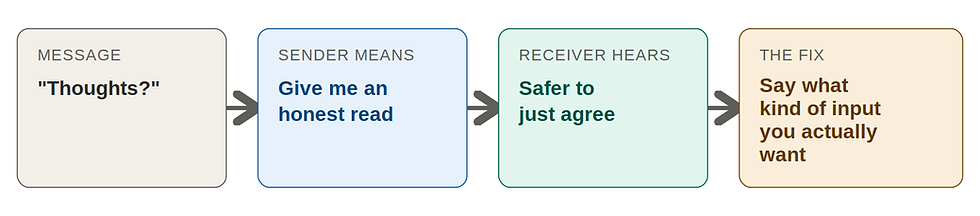
Where it comes from: Usually attached to a draft, a plan, or a decision the client has already mostly made and is checking before moving forward. Also shows up as "what do you think," "does this work for you," or "let me know if this looks off."
What the sender means: I want your honest read before I move forward.
What the receiver hears: I am being asked to approve something, and disagreeing might not actually be welcome.
Why the misread happens: "Thoughts?" is ambiguous about what kind of response is being invited. Critique and approval look identical from the outside, and in relationships where hierarchy is felt strongly, the receiver may default to the safer reading and simply agree.
The fix: Say what kind of input is actually wanted. "Thoughts, specifically, does this need more detail?" or "Thoughts, and I actually want pushback if you see a problem" tells the other person which answer is safe to give.
"I'll take care of it"

Where it comes from: Usually a VA confirming they've picked up a task, meant as reassurance that it's in hand. Also shows up as "no worries, I got it," "on it," or "already looking into it."
What the sender means: I'm handling this specific piece, and I'll flag anything that changes.
What the receiver hears: The whole thing is now handled, end to end, no further input needed from me.
Why the misread happens: "Take care of it" describes intent, not scope. It says nothing about which parts of a task are included, what "done" looks like, or whether related pieces are covered. The client fills that silence with the broadest possible reading, because that's the version that lets them stop thinking about it.
The fix: Spell out what's included. "I'll take care of the outreach emails, but I'll need you to confirm the list first" tells the client exactly where their involvement still matters.
"Should be fine"

Where it comes from: Usually a VA wrapping up a task and giving a status update before fully verifying it. Also shows up as "I think it's done," "looks good on my end," or "that should work."
What the sender means: I finished my pass and didn't catch any problems, though I haven't stress tested it.
What the receiver hears: This has been confirmed and checked, it's safe to move forward without a second look.
Why the misread happens: "Should" is a hedge word, but it doesn't read as one in a fast-moving thread. The client hears the confident half of the sentence and not the qualifier, because a qualifier buried mid-sentence is easy to miss when you're skimming for a status update.
The fix: Separate the confidence level from the completion. "Done on my end, haven't tested the edge cases yet" gives the client an accurate picture instead of a vague reassurance they'll take as certainty.
"Let's sync"
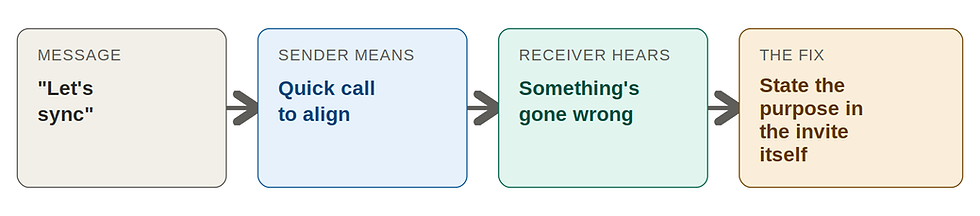
Where it comes from: Sent by either side after a stretch of async-only communication, when someone wants a faster back and forth than messages allow. Also shows up as "got a few minutes to hop on a call," "can we chat about this," or a calendar invite with no subject line at all.
What the sender means: A quick call to align on where things stand.
What the receiver hears: Something has gone wrong and this is about to become a correction conversation.
Why the misread happens: A meeting request that shows up without context after a period of async work tends to get read through whatever emotional lens is already active. If the receiver has been unsure about their own output, or unsure how something they sent was received, "let's sync" gets filed as bad news before the call even happens.
The fix: State the purpose in the invite itself. "Let's sync, just want to align on priorities for next week" costs one sentence and removes an entire day of quiet worry, no matter who sends it.
Communication gaps are common, and that's not a personal failing
These six are examples, not a complete inventory. The goal was never to memorize six danger phrases, it's to recognize the shape a misread takes so you can catch it somewhere these examples don't cover.
Getting read wrong, or reading someone else wrong, isn't a defect in either person. It's a skill most people never got taught, because in-person work used to catch these gaps through tone and body language automatically. Remote work removes that safety net, and nothing replaces it except paying attention on purpose.
Working across a distributed team also means working across different norms for directness, politeness, and disagreement. Blunt to one person can be neutral to another. Evasive to one person can be respectful to another. If a message comes across wrong, ask whether you're reading it through your own cultural default instead of theirs.
Whose job is it to close these gaps? Both, though not equally. The sender holds the context, so they go first. But the receiver isn't off the hook either, checking a read before acting on it works no matter what the sender made clear. Neither side gets to hand this off to the other.
A few signals worth noticing in the moment, on any topic, from either side:
You ask something specific, and the reply answers a different question than the one you asked. That's a scope or intent mismatch already in motion.
You ask for something, and the response takes far longer than the task should, or comes back oddly short. Either way, the other person is unsure what was actually being asked.
The work comes back done, but the result is not what you envisioned, like a detail you didn't expect or a version of the task you didn't picture. That mismatch means the two of you weren't picturing the same thing back when the task was first assigned.
You've asked the same question to clarify the task more than once because the answer never quite settles your confusion. That doesn't mean the other person is being obtuse, it means the original message wasn't clear enough.
The single most useful habit, and it covers every situation these six examples don't: before acting on something ambiguous, say back what you think was meant. "Just to confirm, you want X" costs one line and catches almost everything above, including what hasn't happened yet.
None of this replaces actually knowing the person you work with. That kind of understanding builds the same way any relationship does, through time and attention. Eventually, messages come through correctly almost every time, not because the wording got better, but because two people learned to read each other. People call that finishing each other's sentences. This map only gets you started, the rest is built by paying attention, one conversation at a time.



Comments